

Volume 2: The Goverment Wants Families Out Of The Activity Centres — And Is Selling Out the Next Generation
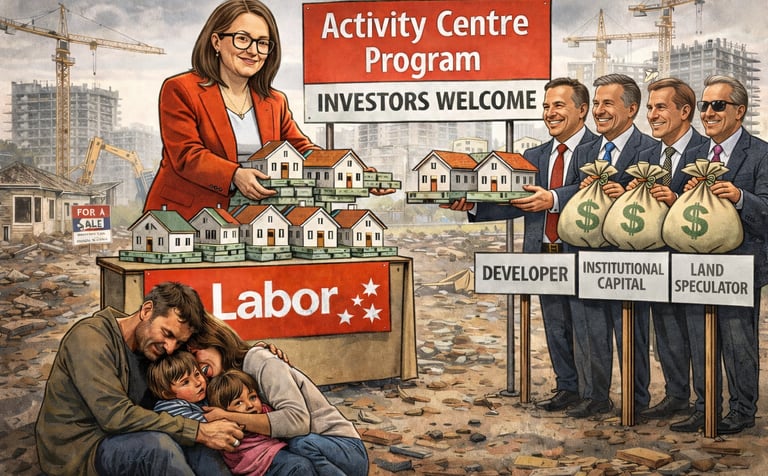
The government’s housing policy is anti-family and anti-ownership. It wipes out scarce family homes in established suburbs, replaces them with small investor apartments, and calls the result “housing supply”. But there is no serious affordability plan — and the shift toward build-to-rent shows where this is heading: a system where institutional capital owns the housing and the next generation pays rent for life. Families lose, young people lose, and the only winners are developers and large investors.
3/6/202611 min read
The Victorian Government has become obsessed with one thing when it comes to housing policy:
announcing big numbers at press conferences.
More homes.
More towers.
More density.
The message is always the same: bigger targets, bigger rezoning programs, bigger housing numbers.
But behind the announcements lies a much more uncomfortable reality.
This government’s housing strategy is increasingly built on quantity over quality, numbers over substance, and profits over communities.
The government’s central promise — that mass upzoning and market-led supply will deliver affordable housing — is highly contested by a range of experts and the evidence. Around the world there are countless examples where similar approaches have failed to deliver meaningful affordability outcomes, and in some cases have made housing markets more volatile and expensive.
We will examine the affordability claim in detail in a separate article.
But even if we assume, for the sake of argument, that simply building more homes is a good thing, a fundamental question still remains:
what kind of homes will actually be built, and who will they be built for?
Because when you examine the housing stock produced by market-led density, a troubling picture emerges.
The Activity Centre Program risks demolishing the very homes that multiple generations are competing for — family-suitable housing with three or more bedrooms and connection to the ground — and replacing them with small investor-grade apartments that simply do not meet those needs.
And when scarce, highly demanded housing is removed from the market and replaced with something less suitable, the result is predictable:
the price of the remaining family-suitable housing only rises further out of reach.
A Housing System Built for Investors — Not Families
Australia’s housing system increasingly reflects a set of policy choices that treat housing as a financial asset first and a place for people to live second.
For decades, tax settings, planning frameworks and investment incentives have prioritised investor demand and capital growth over the needs of owner-occupiers and families.
Housing has increasingly been treated as a vehicle for wealth accumulation rather than a social and economic foundation for stable communities.
The result is a housing system oriented toward producing the types of properties that generate the strongest financial returns, not the homes that best meet the needs of households.
And when you look at how Australians actually live, the mismatch becomes clear.
According to the Australian Bureau of Statistics:
Couple families with children make up around 28–29% of Australian households
Single-parent families make up roughly 11%
Together, households raising children represent around 40% of all households in Australia.
When group households, such as students or young adults sharing housing, are included, the proportion of households that typically require three or more bedrooms rises to around 43–44% of all households.
And even that framing assumes a couple can comfortably live long-term in a two-bedroom home, which is increasingly not true in a work-from-home economy, and certainly not true for couples planning to start a family.
Yet Melbourne’s apartment construction pipeline tells a very different story.
Government housing analysis prepared for the Suburban Rail Loop structure plan shows that since 2015:
36% of apartments built in Melbourne have been one-bedroom units
56% have been two-bedroom units
Only 8% have been three-bedroom units
Which means:
92% of apartments built in Melbourne do not have three bedrooms.
Placed side by side, the mismatch becomes impossible to ignore:
Housing Need - at least ≈44% of households require 3+ bedrooms
Housing Supply - Only 8% of apartments have 3 bedrooms and 92% are 1–2 bedroom dwellings
The market housing system does not produce apartments in a size that a large proportion of households require.
Developers are not doing this in a vacuum. They are responding to the incentives governments have chosen to create. State and federal policy settings have helped inflate housing into an investment class, entrenched investor demand and encouraged the production of properties designed primarily to maximise financial returns.
And now, after decades of policy choices that significantly contributed to the housing crisis, governments are attempting to solve it with a hyper-charged version of the same approach, a market-led supply strategy that relies on investor-grade apartment production and headline dwelling numbers, even though the market outcomes are already telling us it will not deliver the homes communities actually need.
Two Generations Competing for the Same Homes
At the same time, two of Australia’s largest generations are moving through major housing transitions.
Millennials are entering the life stage where many are starting families.
Meanwhile older Australians are increasingly looking to downsize from large detached homes.
But downsizers are not necessarily looking for tiny apartments.
In many cases they are looking for the same housing type as young families:
three-bedroom homes
townhouses or terraces
modest outdoor space
flexible rooms for work or visiting family
proximity to services and established neighbourhoods
And Gen Z won't be far behind. Currently aged between 14 and 29 years, this generation will be demanding the same housing stock in 5 to15 years - well within the government's 2050 timeframe for the Activity Centre Program.
In other words, the strongest demand in the housing market is and will be for family-sized homes in well-located suburbs.
The Homes Australians Actually Want
This mismatch between what households need and what is being built is not just theoretical.
The market itself is already signalling strong demand for family-sized homes and medium-density housing such as townhouses.
Three-bedroom townhouses in particular have become one of the most sought-after property types, offering a middle ground between detached houses and apartments.
They appeal to a wide range of buyers:
young families
first-home buyers
downsizers looking for manageable homes with space
Property search data consistently shows buyers gravitating toward three- and four-bedroom homes, with the classic family configuration — four bedrooms, two bathrooms and two car spaces — regularly emerging as the most viewed property format nationally.
In other words, the market is clearly signalling that Australians want space and flexibility, not just small apartments.
Yet the housing system continues to produce the opposite.
Why Developers Don’t Build Family Housing
Even when apartments are delivered with three bedrooms, they are often not designed for family living.
Modern family life frequently requires more than just three sleeping spaces. Parents increasingly work from home. Children need space to study. Storage requirements are higher than ever.
But apartment developments are driven by yield — the number of units that can be delivered on a site.
That incentive leads developers to maximise apartment numbers rather than maximise liveability.
Bedrooms are squeezed into narrow floorplates.
Living areas are reduced.
Storage is minimal.
Bedrooms are often placed directly off shared living spaces, making privacy difficult.
In practice, many so-called three-bedroom apartments are not genuinely suitable for family life at all.
RMIT University urban planning expert Liam Davies explains the dynamic clearly:
“People will pay more per square metre for a two-bedroom apartment than they will for a three-bedroom apartment.”
Because smaller apartments produce higher returns, developers have a clear financial incentive to build one- and two-bedroom units rather than family-sized homes.
Davies warns that if cities fail to deliver family housing in inner and middle suburbs, the consequences will be severe.
“If we don’t figure out how to provide more three and four-bedroom properties in inner and middle suburbs, cities will become very separated… Middle-income Australians won’t be able to raise families in those areas and will be increasingly forced further out.”
The Warning Signs the Government Is Ignoring
If the government’s theory were correct, that apartments are exactly what the market needs, we would expect strong demand for them during an apparent housing shortage and housing crisis.
But recent market evidence suggests the opposite.
Melbourne currently has thousands of unsold apartments sitting on the market, with estimates suggesting more than 8,000 completed apartments remain unsold.
In some Activity Centre locations targeted for new high rises, apartments are selling at a loss, with owners unable to recover their purchase price. Reports have also highlighted weak demand for apartment developments in outer middle-ring Activity Centres.
These are the very locations the government is upzoning most aggressively on the basis that flooding market built apartments into those markets will somehow solve the crisis.
These signals clearly suggest that the market is not crying out for more small apartments.
It is asking for something else.
What the Activity Centre Program Will Actually Deliver
Fair Growth Thornbury analysed 36 apartment developments approved by Merri-bek Council around the Brunswick and Coburg Activity Centres since 2020.
Only 12% of apartments contained three or more bedrooms.
Just 0.74% contained four bedrooms.
That means fewer than one in eight apartments could realistically house a family.
Upzoning doesn’t just change what can be built — it changes what land is worth. The moment a site can legally carry six storeys, its price is no longer set by what a family can afford for a home to live in, but by what a developer can justify paying based on an apartment yield. Families don’t bid against other families. They bid against development feasibility — and they lose. The result is predictable: owner-occupiers are priced out, and the “new supply” that replaces them is overwhelmingly investor-grade apartments, not family housing.
This is the development model the government is now proposing to replicate across around 60 locations under the Activity Centre Program across Victoria.
Smaller Homes, Lower Standards
Compounding these concerns is the secrecy surrounding the government’s proposed mid-rise housing code, which will regulate apartment developments between four and six storeys in many Activity Centre locations.
Despite the scale of change proposed, the draft code has not been publicly released.
Councils have reportedly been required to treat its contents confidentially.
Early reports suggest the code allows bedrooms without windows and further reduces design standards in order to maximise apartment yields.
Reducing basic design standards does not create better homes.
It simply allows more apartments to be squeezed into the same building envelope. Yet another planning policy designed to suit developers.
From Family Homes to Feudal Rentals
The government’s housing agenda is also increasingly focused on Build-to-Rent housing, where large apartment developments are owned by institutional investors and rented out long term.
In theory this is presented as a housing solution.
In practice it represents a profound shift in how housing functions.
Instead of homes being owned by households, entire buildings become investment assets owned by corporations and financial institutions.
Housing stops being a pathway to stability and wealth creation.
Instead it becomes a permanent revenue stream for institutional capital, and when the build to rent period expires and all the depreciation benefits are used up, they are sold for a tidy tax discounted capital gain.
Over time this creates a system that begins to resemble something closer to a modern form of feudalism, where a small class of investors and institutions own the housing stock and the next generation pays them rent indefinitely for the privilege of living there.
Who Really Benefits
Despite the growing body of evidence questioning this approach, the Victorian Government appears to rely heavily on one organisation for housing policy cover: the Grattan Institute.
Despite not being urban planning experts at all, Grattan has become one of the most prominent advocates of large-scale upzoning and supply-led housing policy in Australia. Governments cite its work repeatedly to justify planning changes like the Activity Centre Program, often as if Grattan’s position represents a settled expert consensus.
But Grattan is not a neutral umpire in this debate.
Like many policy think tanks, Grattan is funded through a mix of government support, philanthropy and corporate contributions. Its donor base includes major corporations and financial institutions, including firms connected to the property development, property investment and financial services sectors — industries that stand to benefit from the Activity Centre Program.
The organisation’s connections within the broader housing advocacy ecosystem also blur the line between policy analysis and policy campaigning. One of the institute’s senior housing program figures sits on the board of YIMBY Melbourne, a lobbying group backed by funding from Californian Tech billionaires with questionable connections actively campaigning for large-scale upzoning across the city.
This raises an obvious question: when governments repeatedly elevate a supply-only narrative and cite a single think tank as their trusted authority, how independent is that authority from the billionaire YIMBY backers and the property-and-finance ecosystem that benefits from upzoning and investor-grade apartment supply?
At the same time, the property development industry and associated sectors, including construction firms, property finance groups and major developers, have long been among the largest political donors in Victoria, and they stand to benefit enormously from sweeping upzoning programs that dramatically increase the development potential of land.
When a government consistently pursues policies that align with the financial interests of its biggest donors while leaning heavily on advice from organisations funded in part by entities tied to property and housing finance, Victorians are entitled to ask the obvious question:
is this housing policy being built for Victorians, or for the interests that profit from the churn?
The Fix: Planning for Communities, Not Just Numbers
The fundamental problem with the Activity Centre Program is not that Melbourne needs more housing. It does.
The problem is that the program treats housing as a numbers exercise, not a community-building exercise.
It assumes that if government simply unleashes the market and allows large-scale upzoning everywhere, the right homes will somehow appear. But the evidence is clear: markets build what is most profitable, not what communities need.
Left entirely to market forces, developers overwhelmingly produce small one- and two-bedroom apartments, because they maximise yield and investor demand. That may increase dwelling counts on paper, but it does not deliver the diverse housing mix that functioning neighbourhoods require.
Planning exists precisely because markets alone do not produce balanced cities.
For more than a century, planning systems have shaped how cities grow, ensuring that housing, infrastructure, services and public spaces develop together to create liveable communities. Planning is how governments shape cities. It is how they decide not just how much growth happens, but what kind of growth happens, where it goes, and what sort of communities it creates.
Yet the Activity Centre Program abandons that principle. Instead of careful, place-specific planning, it imposes a one-size-fits-all model across dozens of suburbs, overriding local context and community input.
It is a blunt instrument where nuance is required.
If the goal is to deliver real housing outcomes, the solution is not to scrap planning — it is to use planning properly.
That means shifting from a market-led approach to a community-led, place-sensitive housing strategy that focuses on the type of housing Melbourne actually needs. And building a planning regime that says to developers - build this here, and if you don't like it, someone else will.
A serious housing strategy would include:
1. Mandating family-suitable housing
If families make up nearly half of households, planning policy should reflect that reality. Governments should require a meaningful proportion of new developments to include three- and four-bedroom homes designed for real family living, not swathes of small investment grade apartments with token oversized apartments priced as luxury penthouses.
Without mandates, the market will simply continue producing what is most profitable.
2. Delivering “missing middle” housing
If the government were serious about delivering better housing outcomes, the answer would not be to step back and let the market rip. It would be to use planning properly.
That means planning for housing diversity, not just housing volume.
Middle-ring suburbs do need more homes. But they need the right kinds of homes:
townhouses and terraces
well-designed dual occupancies
courtyard housing
family-sized low-rise and mid-rise apartments
adaptable homes for different life stages
and, in the right places, carefully integrated higher-density development
3. Returning planning to communities
Finally, planning must return to its core purpose: shaping places, not just approving buildings.
Councils and local communities are best placed to design how density should occur in their neighbourhoods, where it should go, what form it should take, and how infrastructure should support it.
Different suburbs can absorb growth in different ways. Some streets are suited to townhouses and terraces. Some activity centre cores can support larger apartment buildings. Some transitional areas can accommodate gentle mid-rise change. Some local shopping strips can evolve through mixed-use renewal. That is what actual planning looks like: understanding local character, infrastructure, transport, services, and housing need, then shaping growth accordingly.
The current model does the opposite. It overrides nuance in favour of speed, uniformity and yield.
The Bottom Line
The government calls the Activity Centre Program a housing solution. But in practice it’s an anti-family policy and a sell-out of the next generation.
It tells families, plainly: you don’t belong here. It knocks down scarce family homes and prioritises replacing them with an apartment product designed for yield — the kind that suits developers, investors and land speculators. Families get pushed out of the very suburbs that should be best for raising kids — close to transport, jobs, schools and services — while young people are told to accept “housing security” that looks like renting from rich investors forever.
And the political truth is even uglier: this isn’t a planning accident. It’s a choice. A government that won’t lock in affordability requirements, won't build public or affordable housing, won’t transparently release the modelling behind its claims, and won’t plan for proper infrastructure at scale is telling you exactly what matters most — developer profit and headline numbers, backed by a property-and-finance ecosystem that benefits from the destruction of our communities.
We’re constantly being told to blame each other — renters versus owners, boomers versus millennials and Gen Z, neighbours versus neighbours, NIMBYs versus YIMBYs. That’s convenient, because it keeps attention away from where the power actually sits. The real divide isn’t generational. It’s between everyday Victorians trying to build stable and secure lives, and a housing system increasingly shaped to placate property donors and investors, institutional capital, and political spin.
So here’s the question this government won’t answer — and every generation should be demanding: what Melbourne are they building, and who is it for? A city for communities and families — or a city designed around the interests that profit when ordinary people are locked out.
Contact
Get in touch:
© 2025. All rights reserved.
Fair Growth Thornbury acknowledges the Wurundjeri Woi-wurrung people of the Kulin Nation as the Traditional Custodians of the unceded lands on which we live and work. We pay our respects to Elders past, present and emerging.